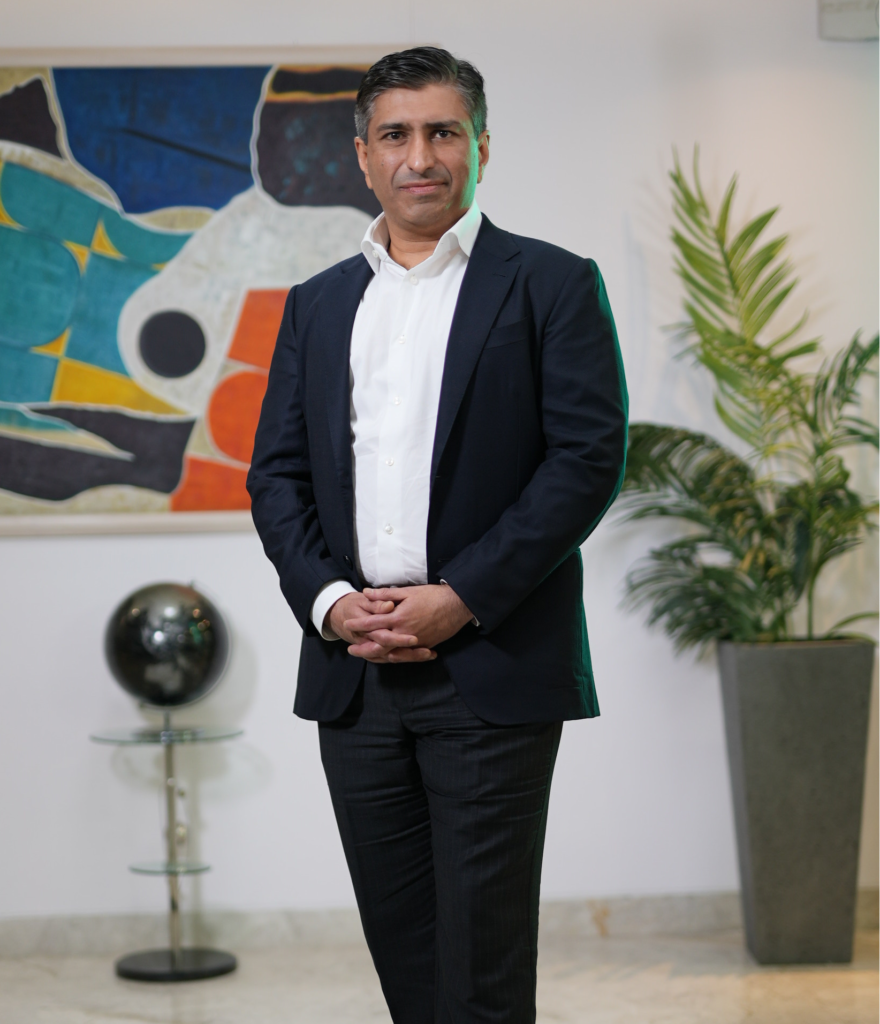
New Delhi: Just like India’s economy is recalibrating globally amid uncertainties and domestically opportunities, the topic of leadership, reform and responsible growth has been gaining more attention. Among the business leaders, promoting such ideas, Ratul Puri is one whose opinions on infrastructure, clean energy and institutional rigour show a change in the way Indian business is redefining success.
Industry watchers point out that this decade is a very significant moment for Indian businesses. Changes in supply chains, technological acceleration and climate commitments are determining the priorities of different sectors. It is in such an environment that Puri has been quite vocal about supporting the Indian growth story being built on long, term thinking rather than short, term growth.
A shifting interpretation of development
Development has become a more complex concept in the last few years. While in the past it was mainly accounted for by size or turnover, nowadays its measurement is more focused on areas such as environment, governance, and social impact. Ratul Puri has been one of those pointing this out, he has argued that companies ought to integrate these new social and environmental expectations into their strategy and operations if they want to succeed in a world economy that is changing rapidly.
He considers that Indias strength as a country rests not merely on its market size or the demographic structure but also on its ability to create institutions that will be trusted by investors, business partners and local communities. According to experts, the message is in line with what the global investors want as they are increasingly concerned about the level of transparency and the prospects of long, term stability.
Infrastructure figures prominently as a recurring topic in Puris public speeches. Most of the time, he has referred to it as the base that allows economic resilience to be developed hence, facilitating trade, mobility and industrial productivity.
In the context of sizable capital commitments in the transport, logistics and energy sectors, Puri has emphasized the significance of implementation and coordination. He is of the opinion that a carefully designed infrastructure can mitigate systemic inefficiencies and, at the same time, open up the potential for productivity growth within sectors as diverse as manufacturing and services.
On the one hand, analysts argue that such perspectives are consistent with the governments overall agenda for the upgradation of Indias infrastructure ecosystem. On the other hand, they also acknowledge that problems like financing, regulatory complexity, and timely execution necessitate a continuous dialogue between the government and the industry.
India’s clean energy goals have, over time, escalated from mere aspirations to unavoidable necessities, largely due to both its climate commitments and sound economic reasoning. Ratul Puri has been consistently sharing the belief that renewable energy and innovation centred on sustainability are the key to India’s future global competitiveness.
Instead of presenting clean energy as an expense, he has said that it should be considered as a capital outlay for efficiency, resilience and energy security. Market insiders comment that this storyline has been supported by the fact that renewable energy technologies are getting cheaper and more scalable.
Puri’s view is in line with the wider understanding among Indian industries that sustainability and profitability are coming to be seen as two sides of the same coin. It is suggested by analysts that those companies which make the changes early will, over time, reap the benefits of being in tune with the regulations and gaining the confidence of the investors.
Leadership in the time of disruption
Currently, the environment for business is full of rapid changes and uncertainty. The Leaders, among other things, are the ones who have to figure out how to use the geopolitical changes and technological creations not to lose their way in this sea of complexity.
Those who have had the privilege to work with Ratul Puri on a one, to, one basis, say that his leadership style is very calm and analytical. Over and above a reactive decision, making process, he supposedly focuses on getting things ready, estimating the risks and looking at the future for a long time. According to the colleagues of Ratul Puri, it is very helpful for the organizations to be able to keep their eye on the ball even when the situation is quite unstable.
Management scholars observe that leadership behaviors are becoming more and more pressing as the operating conditions of the companies are becoming less and less predictable. Anticipating change and adapting strategically are now very much recognized as a core leadership skill. From this perspective, Ratul Puri seems to be an ideal leader of a business in a disruptive environment.